Firms and banks cutting 10% of their workforce; graduate and entry level vacancies dwindling; and many employers planning headcount reduction.
And one of the main narratives that goes to explain this reduction, is that AI will eliminate entry-level professional roles. The logic goes that as these roles are the simplest and most routine, they are the easiest to automate. If we accept this narrative, it raises some serious questions including:
- How do we ensure a pipeline of capable future leaders, if entry level roles disappear?
- How will young people enter the workplace and establish a sense of place in society?
But before we accept that conclusion, it’s worth examining the narrative itself.
We know that the stories we tell each other shape behaviour, frame the questions we ask, and then drive the actions we take.
So, let’s review the present situation.
A lack of entry level roles today does not mean every entry level role is being done by AI. It is not cause and effect. Outside of a select few companies with well-structured data sets, most organisations are struggling to scale AI or deliver meaningful financial returns from it. The average UK organisation simply does not have the required data maturity, governance or architecture to move AI beyond being a tool that speeds up people’s work.
Indeed, according to a recent McKinsey report – 88% of organisations are now using AI, yet over 80% see no impact on profit at all.
A world of self-managing AI Agents, effortlessly performing tasks, saving money and replacing whole teams of people, is far away in the average organisation. For most organisations AI is a J-curve investment: requiring time and money now, on the promise of future returns. What’s often missing is the corresponding investment in the people and the organisational design needed to capture these returns. For now, economic forces are driving head-count reduction as much as technology ones.
For those in People or HR roles, this situation presents a dilemma. We know there is a desire to reduce overheads using AI, but also that for most of us, our organisation is not able to replace people with technology. Against these conflicting narratives I believe we must champion our organisations’ need for both future technology AND talent as one interconnected whole.
But there is one other simplistic narrative we must challenge:
The personification of AI.
AI tools and Agents give the impression of a person doing work. This personification of AI is encouraged by tech vendors, who give AI tools names and shiny faces, making it easy for leaders to imagine AI as a digital employee.
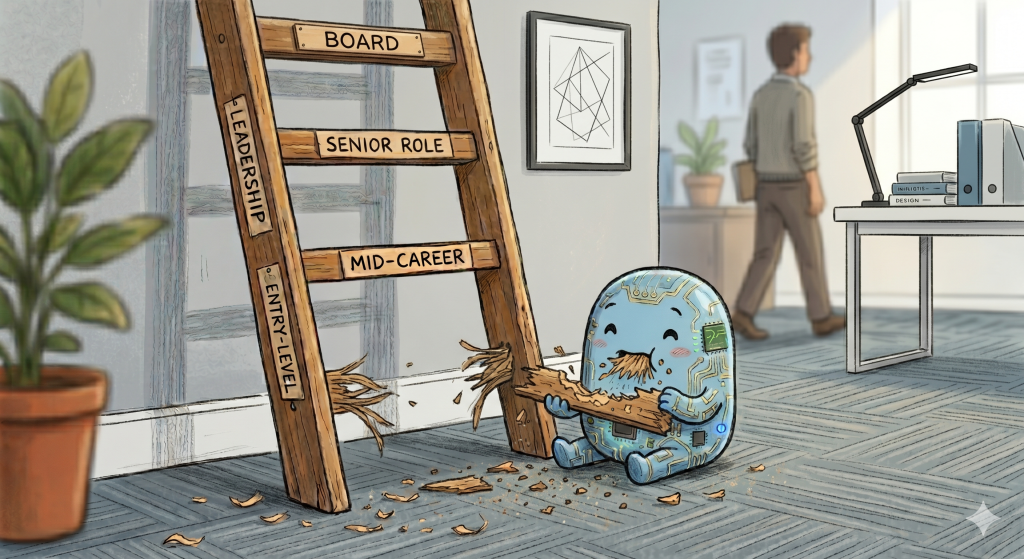
Yet AI is just a computer, doing some clever maths, in a massive energy and resource intensive data centre. AI does not have many of the core capabilities of a person, like situational awareness, or the ability to form relationships. Entry-level roles are how humans build those capabilities and progress to senior roles. Cut the rung, lose the ladder. And while we’ll need to redesign how juniors learn in an AI world, we can’t redesign the pathway if we’ve removed the people.
And a final point of personification of AI: Don’t put AI Agents on an org chart, as a person. Otherwise, the delusion is complete!
So, if you are an People or HR role, I encourage you to treat technology and talent as one interconnected whole, particularly if your organisation is cutting talent today to fund technology for tomorrow. Start by putting staffing costs and AI spend on the same board paper, with the same five-year horizon. And don’t shy away from bringing broader societal issues into this discussion. The broader costs of AI into the future are unknown, whereas developing entry level talent is a well proven strategy.
So, is AI eating your entry level roles? In most cases it’s not. But the stories we tell about it just could be.
Luke Hutchison – Partner, People Advisory